Nutrition Evidence
Progress Made, Gaps Remain: What NFHS-6 Tells Us About India's Nutrition Challenge


Progress Made, Gaps Remain: What NFHS-6 Tells Us About India's Nutrition Challenge |
More children are eating better than ever before. But most still aren't eating well enough.
What has changed since NFHS-5?
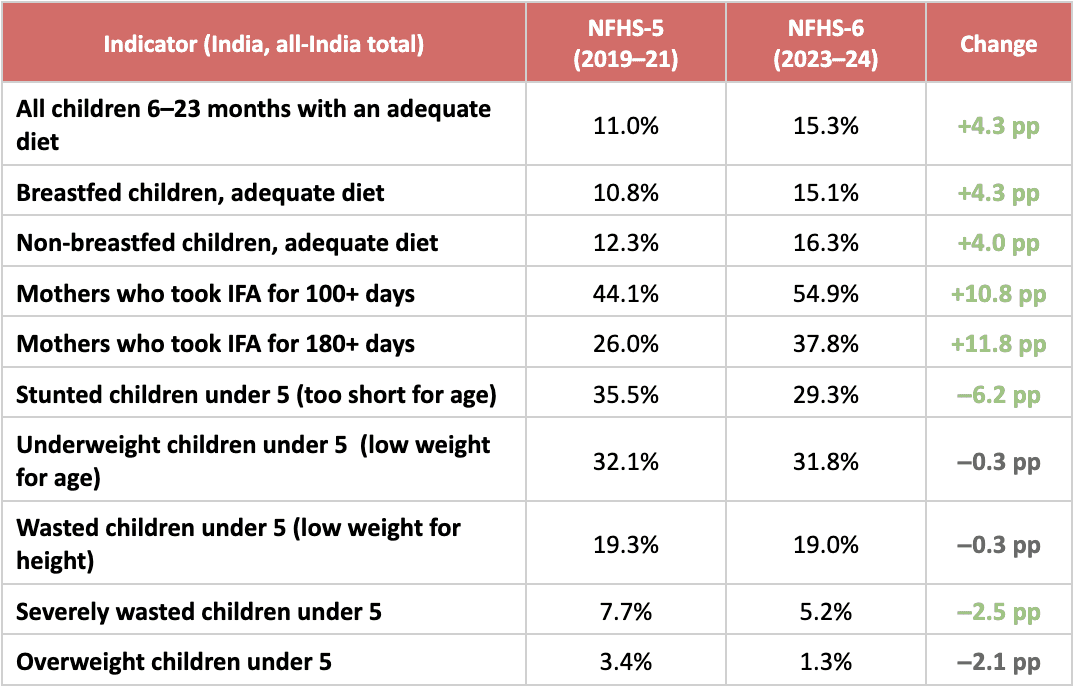
We focused on three groups of indicators that sit close to our work: the quality of young children’s diets, the nutritional status of children under five, and how many mothers received iron-folic acid (IFA) during pregnancy. Here is how India moved between the two rounds—all figures are all-India totals.
The story behind the numbers
The encouraging thread is real. More mothers are taking iron-folic acid supplements. More toddlers are getting a more varied diet. These are not trivial gains. Behind every percentage point are millions of children.
Why does “adequate diet” matter so much? Because a child can be fed enough to feel full and still miss the iron, zinc, vitamin A, and other micronutrients that build bodies and brains in the first 1,000 days. Adequate diet is a measure of quality, not just quantity. When that quality stays low, the gains we can see — in feeding and in supplementation — may not fully translate into the outcomes we can’t yet see.
Some of that progress is beginning to show up in children's growth indicators. Fewer children are severely stunted or severely wasted than four years ago. Yet the challenges ahead are substantial. Roughly one in three children remains stunted or underweight, and wasting rates have barely moved. Closing these gaps will require coordinated action across dietary quality, healthcare access, and household economic stability.
A child can be fed enough to feel full and still miss the nutrients that build a body and a brain.
One important number is still missing
There is one number conspicuously absent from NFHS-6: anaemia. For the first time, the survey does not report how many children, women, or men are anaemic. Those estimates are instead being measured through a separate national effort — the Diet and Biomarkers Survey of India (DABS-I), led by the Indian Council of Medical Research’s National Institute of Nutrition (ICMR-NIN).
The reason is methodological. Earlier rounds estimated haemoglobin from a finger-prick (capillary) blood sample using a portable device — an approach many researchers argued could misstate anaemia levels. DABS-I uses venous blood, drawn from a vein, the more reliable standard. Getting the measurement right genuinely matters.
Still, the gap is real in the meantime. Anaemia is one of the clearest windows we have into micronutrient status—especially iron—and it’s tied closely to children’s development, women’s health in pregnancy, and the energy people have to learn and work. We can now watch those inputs improving, but until DABS-I reports, we can’t see whether the micronutrient picture is improving with them. That’s why so many nutrition stakeholders are waiting for its findings.
Why anaemia matters
It is a direct signal of iron and other micronutrient deficiencies. Without it, part of the nutrition story stays out of view.
What this means for Fortify Health
We read NFHS-6 with cautious encouragement. Diets are slowly diversifying, supplementation is reaching more mothers, and several growth indicators are heading the right way. These are signs that nutrition systems can move.
They also reinforce something we see in our own work on wheat flour fortification: improving what people eat and improving the micronutrient content of what they eat are related but separate jobs. Dietary diversity can rise while iron, folic acid, and other micronutrient intakes still fall short—especially where staple foods dominate the plate. That is the gap fortification is designed to help narrow: adding essential micronutrients to foods people already eat every day.
Looking ahead
NFHS-6 tells an encouraging story about inputs: children are being fed a little better, and more mothers are getting the supplements they need. The harder question is whether those inputs are reaching where they’re meant to — the iron in a child’s blood, the growth in their early years, the energy to learn and play. Some of that we can already see. Some we won’t know until DABS-I arrives.
Source: International Institute for Population Sciences (IIPS). (2026). National Family Health Survey (NFHS-6), 2023–24: India and State/UT Fact Sheets. Mumbai: IIPS.
Related blog