Nutrition Evidence
How Much Wheat Are Indians Really Consuming? Insights from the HCES 2022-23


Wheat consumption patterns in India are changing, and so is the fight against anaemia. The latest Household Consumption and Expenditure Survey (HCES) 2022-23 reveals shifts in cereal consumption across states, impacting how we approach wheat flour fortification. In 11 Indian states, wheat consumption accounts for more than 50% of the total cereal consumption. Understanding these trends is critical to strengthening Fortify Health’s fortification program and tackling iron deficiency anaemia effectively.
About the HCES survey
The Household Consumption and Expenditure Survey (HCES) is a crucial dataset published by the Government of India once every decade. It provides detailed information on the monthly per capita consumption of various food items, consumer goods, and the Monthly Per Capita Consumption Expenditure (MPCE) for these items. The most recent HCES survey was conducted in 2022-23, and the preliminary report (Report no. 591) was released in June 2024.
Importance of HCES data for Fortify Health’s chakki atta fortification program
Understanding consumption patterns of wheat and wheat flour in India is crucial for Fortify Health’s initiatives, as it provides state-wise information on food consumption, including wheat. We have used this information to calculate the beneficiaries we reach through consumption of fortified chakki atta. The HCES data serves as a reliable source for this information, and we also use it for the strategic planning of the expansion of wheat flour fortification efforts in India.
Key takeaways from HCES 2022-23
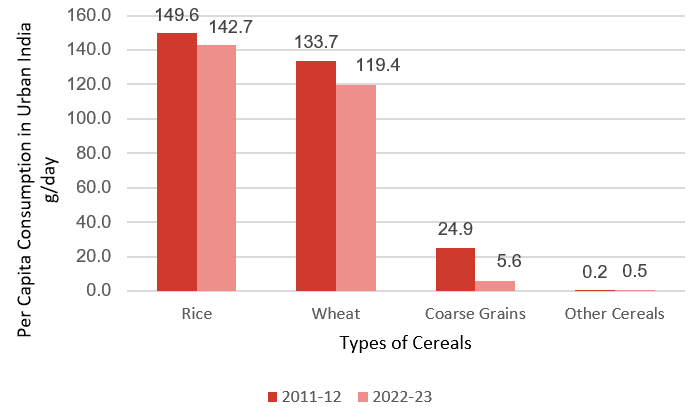
Cereal Consumption in India is Declining (Figs. 1 and 2)
Data from the survey shows that overall cereal consumption has dropped significantly between 2011-12 and 2022-23. On average:
Rural areas saw a decline of 53.5 grams per capita per day
Urban areas saw a decline of 41.1 grams per capita per day
The most significant decline was observed in rice consumption among the rural population, while coarse grains such as millet saw a reduction in both rural and urban areas. Wheat consumption also declined slightly across both groups.
Fig. 1: Cereal consumption in rural India
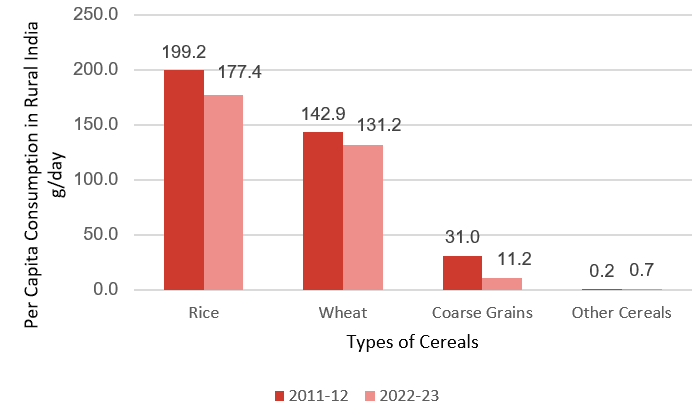
Fig. 2: Cereal consumption in urban India
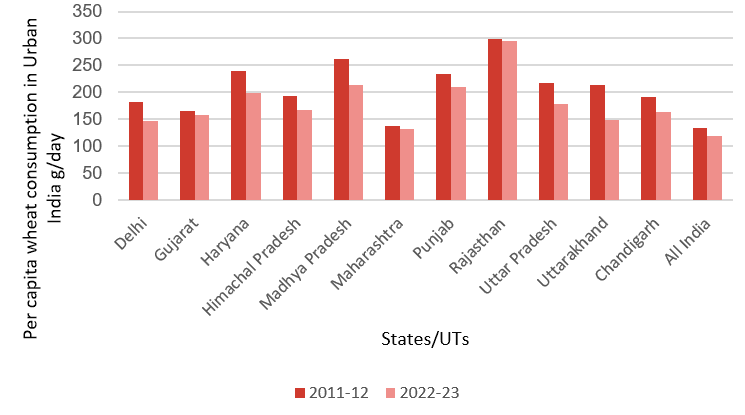
Wheat is the Staple in 11 Key States (Figs. 3 and 4)
While India is diverse in food habits, wheat remains the primary staple in 11 states, where it accounts for more than 50% of total cereal consumption. A total of 38% of the Indian population resides in these 11 states in 2023, as per the population projection report 2020 by the National Commission on Population.
Rajasthan, Haryana, Madhya Pradesh, and Punjab have the highest per capita wheat consumption. However, wheat consumption in these states decreased from 2011-12 to 2022-23, with the exception of Gujarat, where wheat consumption increased in both rural and urban populations.
Fig. 3: States with more than 50% contribution of wheat in cereal consumption in rural India
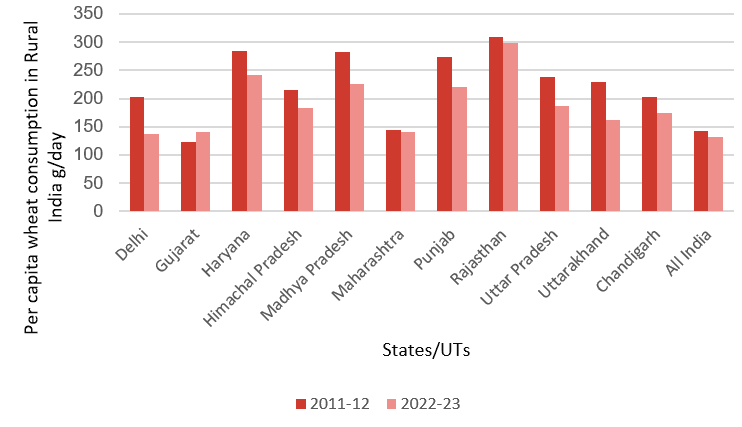
Fig. 4: States with more than 50% contribution of wheat in cereal consumption in urban India
Anaemia prevalence in top wheat-consuming states (Fig.5)
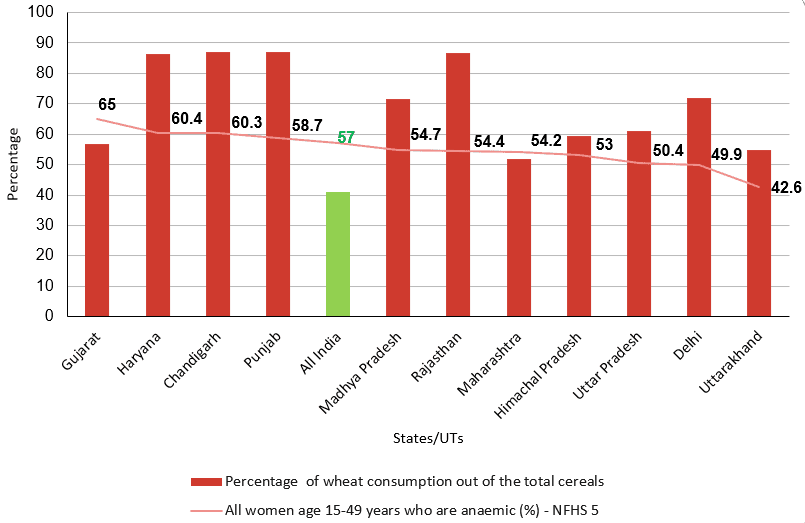
According to the National Family Health Survey (NFHS-5, 2019-21), top wheat-consuming states also have high rates of anaemia among women aged 15-49.
Gujarat has the highest prevalence of anaemia, while Haryana, Chandigarh, and Punjab have anaemia rates above the all-India average. In all of these states, wheat consumption accounts for more than 55% of total cereal consumption. Other states also show anaemia prevalence rates of 50% or higher, except Uttarakhand.
Fig. 5: Wheat consumption and Anemia status in top wheat-consuming states
What this means for Fortify Health
The HCES 2022-23 data plays a crucial role in shaping Fortify Health's strategies and action plans. Chakki atta contains an average of 41 mg/kg of iron, according to the Indian Food Composition Table 2017. The decline in wheat consumption across major states indicates a lower intake of dietary iron from wheat.
Expediting Fortification Efforts: The HCES 2022-23 data helped Fortify Health expedite fortification efforts in states like Gujarat, Haryana, Uttar Pradesh, and Rajasthan through open-market wheat flour mill partnerships and toward Chandigarh and Punjab via government partnerships. The combination of higher wheat consumption and high anaemia prevalence in these states made them priority areas for our chakki atta fortification program to achieve maximum impact.
Strategic Expansion: Looking ahead, we plan to expand our efforts in Himachal Pradesh and Uttarakhand. Given its high anaemia prevalence and increasing wheat consumption, Gujarat can be a key focus for our work moving forward. These strategic decisions are directly informed by the detailed consumption and health data provided by the HCES 2022-23.
Our strategies are guided by data and aimed at making fortification accessible where it’s needed most. If you're curious about Fortify Health’s fortification efforts, check out our external dashboard for real-time updates.
Related blog